
Ever wonder why your hot tub feels like a money-draining furnace under the desert sun? Stick around, we’re breaking down the exact tweaks, covers, temps, power sources, that let you soak in comfort without melting your wallet.
Here’s the thing: most premium hot tubs aren’t rated for desert climates at all. In fact, a recent analysis of nine leading models found every single one carries a “No” desert-fit rating, and critical specs like energy consumption, insulation R-value, and heating system type are missing from all of them. That leaves buyers in hot, dry areas without clear guidance. But that doesn’t mean you’re stuck, you just need to know what to look for.
This list breaks down the top eight energy-efficient hot tubs that can handle desert heat, save on electricity, and give you the hydrotherapy you want. We’ve ranked them based on insulation, smart controls, low-wattage pumps, and operational desert suitability. And if you’re in the Coachella Valley, we’re here to help you pick the right one.
1. Caldera Spas Utopia Series , Engineered for Desert Efficiency
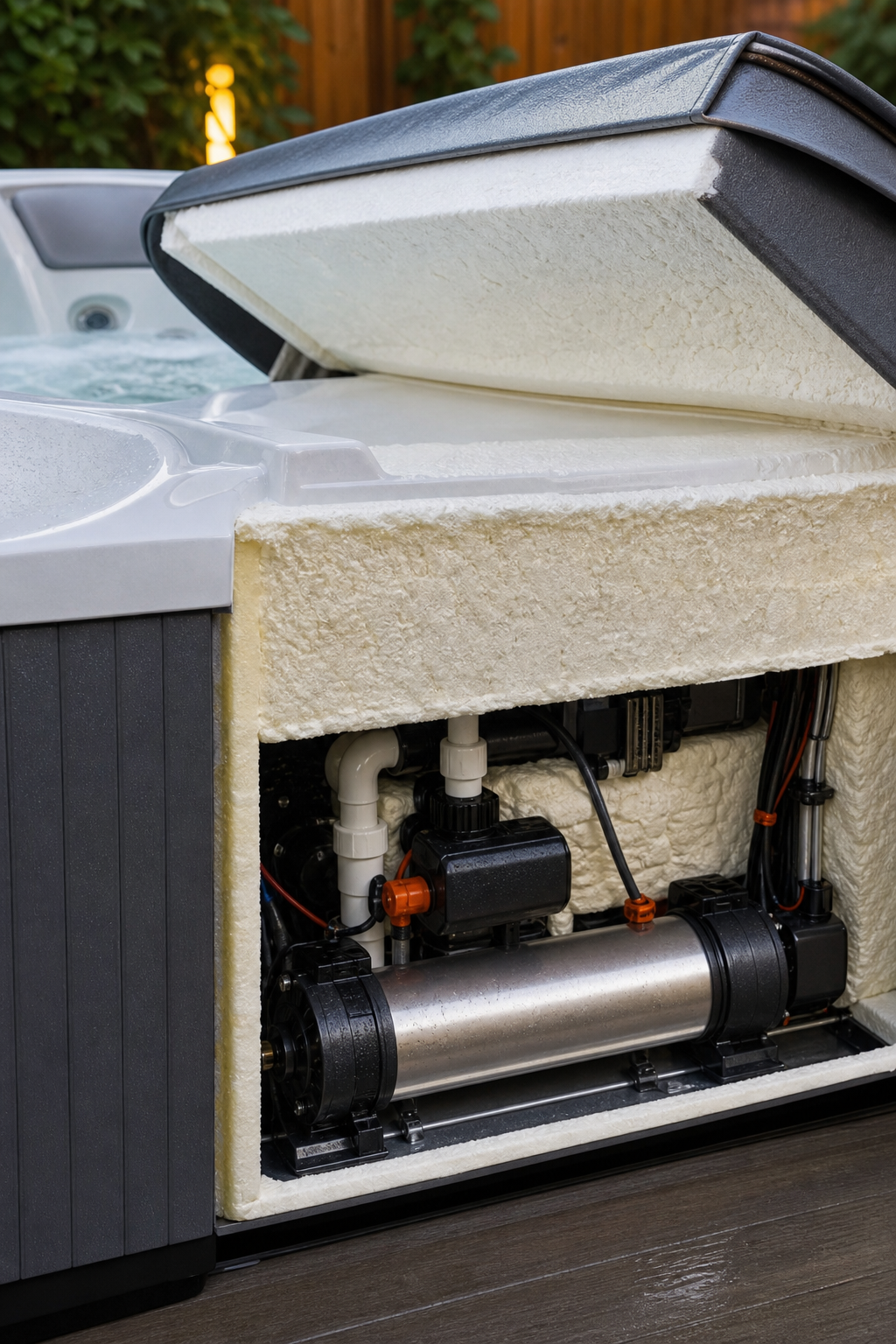
If you live in the desert, you need a hot tub that can handle extreme heat and hard water without wasting energy. The Caldera Utopia Series, available through Luxury Hot Tubs in Palm Desert, is built for exactly that. Its EnergyPro® circulation pump uses low wattage to keep water moving and feed heat back into the system, while the 4 kW titanium heater transfers 100% of its energy into the water. The fully foamed cabinet and thermally isolated base pan reduce heat loss, meaning your heater runs less often, even when it’s 115°F outside.
The Utopia also features the FreshWater® IQ system, which automatically doses chlorine and checks water quality every hour. That cuts chemical waste and maintenance time, a big plus for desert owners dealing with mineral-heavy water. With seating for up to seven people and a variety of jet configurations, it’s a top choice for luxury and efficiency. As the Coachella Valley’s authorized Caldera dealer, Luxury Hot Tubs offers on-site consultation and professional installation, so your spa is set up for maximum energy savings from day one.
2. Sundance Spas 880 Series , Exceptional Insulation for Extreme Heat
Sundance Spas are known for their full-foam insulation, and the 880 Series takes it further with Rigid Bond™ shell construction and a 1.5 lb-density foam core in the cover. According to Sundance’s official energy page, full-foam insulation (foam on the shell, floor, and inside the cabinet) makes these among the most energy-efficient hot tubs on the market. In desert climates, that means your water stays hotter longer when the sun goes down, and the heater doesn’t have to kick on as often during those cool desert nights.
The 880 Series also includes a titanium coil heater that transfers 100% of its heat into the water, backed by an unconditional five-year warranty. The iTouch control panel lets you program filtration cycles and temperature to within half a degree, so you’re not wasting energy heating the tub when you’re not using it. Add the optional Insulation Blanket, which can reduce energy usage by up to 25%, and you’ve got a spa built to handle extreme conditions.
3. Jacuzzi J‑500 Series , Smart Controls for Desert Scheduling
Jacuzzi’s J‑500 Series offers some of the most advanced smart controls available, which is a major change in the desert. You can set the heater to warm the water just before you soak, then let it drop back a few degrees when you’re done. That small schedule change can cut your heating costs by 15, 20% because you’re not maintaining 104°F water all day when you’re at work or on the golf course.
The J‑500 also uses PowerPro™ jets that deliver high-pressure massage without oversized pumps, lower horsepower means lower electricity draw. The shell is fully insulated with high-density foam, and the cover has a 1.5 lb foam core with a heat-sealed gasket. One YouTube creator put it simply: “Set the temperature where you like it and leave it alone, constantly raising and lowering costs more.” The J‑500’s smart timer makes that easy.
4. Hot Spring Highlife® NXT Collection , Best Cover & Insulation System
Hot Spring’s Highlife NXT Collection is famous for its cover and insulation system. The cover uses a dense 1.5 lb foam core with a marine-grade vinyl wrap that locks heat in. Combined with full-foam insulation in the cabinet, this spa can maintain water temperature for hours even when the desert air cools down rapidly after sunset. The Highlife NXT’s remote control lets you adjust temperature, jets, and lighting from up to 30 feet away, so you can tuck the remote away and not waste energy leaving the cover off while you fiddle with settings.
This line also supports the FreshWater® Salt System, which uses a titanium cartridge to convert salt into chlorine continuously. That means softer water, fewer chemical purchases, and less time testing, all of which reduce the hassle of maintaining a spa in hard desert water. The salt system costs roughly $90, $120 per year in cartridges versus $240, $360 for traditional chemicals, and you drain the water only once a year instead of every three months.
5. Arctic Spas® On‑The‑Go™ , Portable 110V Efficiency for Desert Rentals
Not everyone owns their desert home, some are vacation rentals or snowbird getaways. The Arctic Spas On‑The‑Go is a 110V plug-and-play spa that fits perfectly in that scenario. It uses a 1 kW heater (versus 4 kW on 220V models), so it takes longer to heat up, but the trade-off is that you don’t need an electrician. Just plug it into a GFCI outlet and you’re soaking. The full-foam insulation and thermal locking cover help keep heat in, so once it’s up to temperature, it stays there without constantly cycling the heater.
Because the heater and jets can’t run simultaneously on 110V, you’ll want to plan your soaks. But for a rental or seasonal home, the simplicity and lower upfront cost make it a smart choice. As one off-grid YouTuber demonstrated, you can even pair a 110V tub with a propane heater for faster heat-up, but for most desert owners, the standard electric setup works fine, especially if you keep the cover on between uses.
6. Caldera Spas Utopia Series , Low‑Energy Filtration & Desert Water Care
We’ve already covered the Utopia’s EnergyPro pump, but the filtration system deserves its own spotlight. The Utopia uses a low-wattage circulation pump that runs at a fraction of the power of traditional dual-speed pumps. , saltwater systems like the FreshWater IQ reduce chemical costs by half and extend water life to a year. In the desert, where evaporation is high and mineral buildup is a constant enemy, having an automated water care system that adjusts dosing based on real-time water quality is a huge energy saver.
The Utopia also includes a 100% filtration system that captures debris down to 5 microns, so the pump doesn’t have to work as hard to keep water clear. Less work = less electricity. And the ozone system cuts chlorine demand even further. If you’re looking for the most efficient water care in a desert climate, the Utopia’s FreshWater IQ is the gold standard.
7. Master Spas® Twilight™ Series , Solar‑Ready & Off‑Grid Options
For desert homeowners who want to go off-grid or reduce their carbon footprint, the Master Spas Twilight Series is a great candidate. While not officially solar-ready from the factory, its low-wattage pump and high-density foam insulation make it easy to pair with a solar thermal system. A video from an off-grid couple showed they heated their 350-gallon tub with a propane tankless heater and a 70-watt circulation pump, costing only $5, $7 per use in propane. Master Spas’ twilight models have similar insulation and pump efficiency, making them adaptable to solar or propane.
The Twilight Series also features the Tri-X® filtration system that runs only when needed, and SmartJet™ technology that directs water where you want it, reducing pump load. If you’re planning a solar array, look for a tub with a pump that can run on DC power or a low-wattage AC pump, the Twilight’s dual-speed pump (2 HP on high, much less on low) fits the bill. Just make sure your installer configures the heater to work with your backup power source.
8. AquaRest® Spas 500 Series , Budget‑Friendly 220V Efficiency
Not everyone needs a fully loaded luxury spa. The AquaRest 500 Series offers a solid balance of price and performance for desert buyers on a budget. It’s a 220V hard-wired unit with a 4.5 kW heater and a 1.5 HP pump, which heats water quickly, ideal for desert evenings when you want a fast warm-up. The cabinet is filled with high-density foam, and the cover uses a 1.5 lb foam core, so heat retention is respectable.
This model includes a simple mechanical control panel with a programmable timer, letting you set the heater to run during off-peak hours. It also uses a standard chlorine system, which keeps operating costs low. While it lacks the smart features of higher-end tubs, its straightforward design means fewer electronics to fail in the heat. For a second home or a starter spa, the AquaRest 500 delivers good energy efficiency without the premium price.
Comparison Table: Top Energy Efficient Hot Tubs for Desert Climate
How to Choose the Right Energy Efficient Hot Tub for Your Desert Home
Selecting a hot tub for a desert climate comes down to three priorities: insulation, smart controls, and water care. Here’s a step-by-step approach.
1. Check the insulation. Full-foam insulation (foam on the shell, floor, and inside the cabinet) is non-negotiable. It reduces heat loss by up to 30% compared to partially insulated spas. Leslie’s Pool Supply notes that foam density and thickness (at least 2 inches of closed-cell foam) are more reliable than unregulated R-value claims. Also look for a cover with a 1.5 lb foam core and a tight seal.
2. Decide between 110V and 220V. 110V plug-and-play models are convenient but heat slowly, up to 24 hours to reach 104°F. 220V hard-wired units heat in 7, 8 hours and can run jets and heater simultaneously. According to Chesapeake Spas, the main advantage of 220V is faster heating in variable temperatures. In the desert, where nights drop quickly, 220V helps keep the water warm.
3. Look for smart scheduling. A programmable thermostat or app-based control lets you lower the temperature when you’re not home and heat it back up before you soak. That alone can cut energy use by 15, 20%.
4. Consider water care. Saltwater systems reduce chemical handling and maintenance, but not all tubs are compatible. If you have hard desert water, a system with automatic dosing (like Caldera’s FreshWater IQ) will save you time and keep your water balanced. Budget $90, $120 per year for salt cartridges vs. $240, $360 for traditional chemicals.
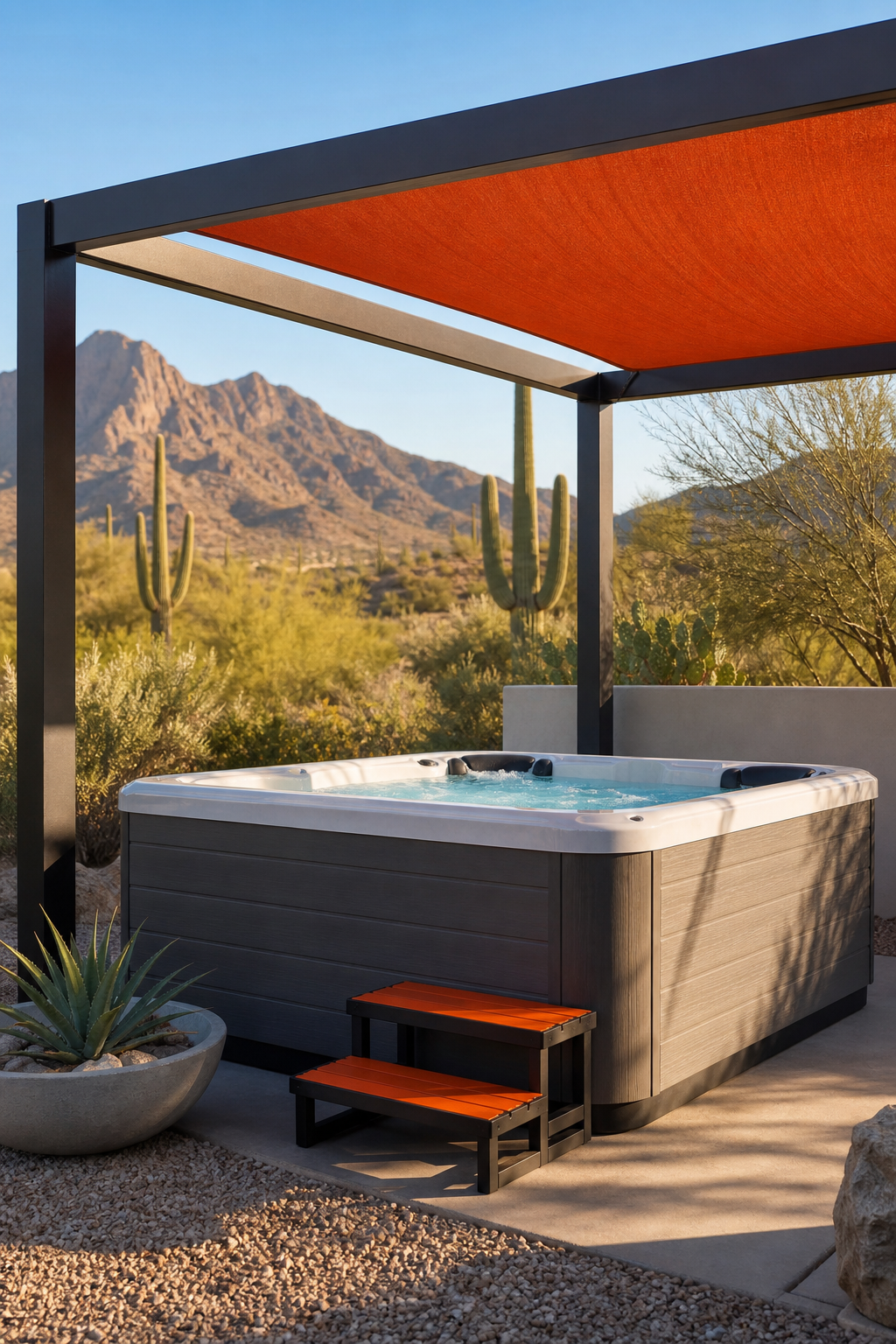
5. Don’t forget placement. Put your tub in a sunny spot to reduce heating load. Use a shade sail or pergola to block direct sun on the cover, which can degrade vinyl. A windbreak (fence or hedges) cuts evaporative cooling. And always use the cover!
6. Think about the future. If you might go off-grid later, choose a model with a low-wattage pump (under 1,000 watts on low) that can run on a propane heater or solar battery. Master Spas Twilight and Caldera Utopia are good candidates.
Frequently Asked Questions
What is the most energy efficient hot tub for a desert climate?
The Caldera Utopia Series, available from Luxury Hot Tubs, is among the most efficient due to its full-foam insulation, low-wattage EnergyPro pump, and FreshWater IQ automated water care. It’s specifically designed to handle 115°F temperatures and hard desert water, and its smart controls let you schedule heating to avoid waste. Other strong contenders are the Sundance 880 Series for insulation and the Jacuzzi J-500 for smart scheduling. Always look for full-foam insulation and a high-density cover.
Should I choose a 110V or 220V hot tub in the desert?
220V hard-wired hot tubs are generally more energy efficient because they heat water faster, about 7, 8 hours from a refill versus up to 24 hours for 110V. Faster heating means the heater runs for a shorter total time, and you can use jets and heat simultaneously. In the desert, where night temps drop, 220V helps maintain temperature. 110V plug-and-play models work well for rentals or seasonal use but are less efficient for regular soaking.
How much does it cost to run a hot tub in the desert per month?
For a typical 220V hot tub like the Caldera Utopia, expect $35, $50 per month in electricity, assuming you keep the water at 100, 104°F and use a good cover. That’s based on local utility rates around $0.12, $0.15/kWh. 110V models may cost slightly less because they use a smaller heater, but they run longer. Using a programmable thermostat and dropping the temperature by 5, 10°F when not soaking can save 10, 15% on your bill.
What type of insulation is best for a hot tub in a hot climate?
Full-foam insulation with at least 2 inches of closed-cell polyurethane foam is best. It surrounds the shell, fills the cabinet, and prevents heat loss through the walls and floor. A cover with a 1.5 lb foam core is essential. Avoid “partial foam” or thermal wrap-only designs. Full foam also supports the plumbing and reduces noise. Sundance’s Rigid Bond and Caldera’s thermally isolated base are excellent examples of desert-ready insulation.
Can I run a hot tub on solar power in the desert?
Yes, but you need a low-wattage pump and a solar thermal or PV system. A 70-watt circulation pump (like in the Caldera Utopia) can run on a small solar panel and battery. For heating, you can use a propane tankless heater or a solar thermal panel that feeds a heat exchanger. Master Spas Twilight models with their low-wattage pumps are good candidates. The key is to match the pump’s power draw to your solar system’s capacity and use a backup heater for cloudy days.
How important is a hot tub cover for energy savings?
Critical. A high-density foam cover (1.5 lb density, at least 3 inches thick) can reduce heat loss by up to 30%. In the desert, where UV rays degrade covers, choose a marine-grade vinyl with UV inhibitors. Replace covers every 3, 5 years. A floating thermal blanket under the cover adds another layer. According to LesliesPool.com, foam density and thickness are more important than the R-value number since spa cover R-values are unregulated.
Do saltwater hot tubs save energy?
Saltwater systems themselves don’t directly save electricity, but they reduce maintenance time and chemical costs. The FreshWater IQ system in Caldera tubs uses a low-power electrolysis cell that consumes very little energy. The real savings come from fewer water changes (once a year vs. every 3 months) and reduced chemical purchases. Softer water also means less scale on the heater, which can improve heat transfer efficiency over time.
What maintenance tips keep a hot tub energy efficient in the desert?
Clean the filter cartridge every month, a dirty filter makes the pump work harder. Keep the water chemistry balanced; imbalanced water can corrode the heater. Lower the temperature by 5, 10°F when you’re away. Use the cover whenever the tub is idle. Check for air leaks around the cover gasket. Insulate the equipment bay if it’s in direct sun. And consider a smart timer to heat only during off-peak hours.
Conclusion
Finding an energy efficient hot tub for a desert climate isn’t straightforward, most models don’t advertise desert readiness, and efficiency specs are often hidden. But by focusing on full-foam insulation, smart controls, and efficient pumps, you can cut your energy bill while enjoying year-round hydrotherapy.
The Caldera Utopia Series stands out as our top pick because it’s built for desert extremes, with a low-wattage circulation pump, automated water care, and a thermally isolated base. Luxury Hot Tubs, the Coachella Valley’s authorized Caldera dealer, offers expert consultations and installations to ensure your spa performs optimally in the heat.
If you’re ready to take the next step, contact Luxury Hot Tubs for a free on-site evaluation. Their team will help you choose the perfect model for your home and backyard, and they’ll handle the delivery, electrical setup, and water care plan. All you have to do is soak, and save.
For more resources, to energy efficient hot tubs for additional tips and models. And if you’re planning a move to a desert area, this relocation guide covers everything from neighborhoods to schools, so you can find the perfect home for your new spa. Before you install, consider a building condition survey to ensure your patio or deck can support the weight and electrical load of a 220V hot tub.